

The story of the post-Blair Labour Party, if it can be contained in one individual, is the story of Ed Miliband. This is not a story about backstabbing brothers, back-room deals with “union paymasters”, election promises engraved on stone tablets, questionable slogans on mugs, bacon sandwiches or double kitchens; nor anything as vulgar as retail policies aimed at marginal constituencies.
Miliband’s story is really about the exhilaration of ideas: where they come from, why some of us fall in love with them, and what propels those ideas from the fringes of the debate to the fulcrum of an era. This is not an argument about whether those ideas and the policies they eventually become are right or wrong. It’s a story about the long-term political power that commanding those ideas allows an individual to wield. It is about the years of Edward Samuel Miliband – and Milibandism – which might be seen as the latest, or perhaps even the last, attempt to restore a social democratic political economy in Britain.
Since July 2024, when Labour returned to government, it has been hard to work out precisely the point of this administration: to spend a bit more here and there, but leave an abject economic settlement largely intact; or to be much more than that, to fundamentally reshape Britain? For the past 20 months, Miliband has stood distinctly apart from those growing doubts. Even his enemies admit that the Minister for Energy Security and Net Zero knows what he is doing. That, in large part, is why he is so hated by his opponents. Miliband is getting social democratic things done at scale – during an era of uncontrollable global conflict, which began with the Ukraine war and is spiralling in Iran, when the direction of energy policy has become the most fiercely disputed issue in British politics.
Miliband and his ideas have become a lightning rod for opponents of this government. (“Eco-zealot”, “madman”, “hysterical eco-obsessive” – these are Fleet Street editorials’ relentless tribute to his perceived threat.) And yet, as one of those critics, a source who had worked with Miliband during his leadership of the Labour Party between 2010-15, grudgingly admitted: “There is something about Ed that is significant. He is a symbolic figure… the last flickering of social democracy.”

North Wales, 13 November 2025: Ed Miliband’s day started just after 4am. He had to get to Anglesey, go on the Today programme, Times Radio and Sky News, announce the creation of new nuclear power stations, deal with the latest ructions in the Labour Party and take questions from the New Statesman.
The announcement was pure Milibandism. New small modular reactors (SMRs), publicly owned by Great British Energy-Nuclear, designed by Rolls-Royce, will be built in Wylfa, on Anglesey. After decades of low investment in British nuclear power, Miliband was clearing the ground for a future of self-sufficient, independent energy, controlled from Whitehall and Aberdeen, not by foreign-owned companies and their shareholders, nor dependent on the whims of petro-states. Public ownership was the key to the whole thing, a way of threading social democratic DNA into crucial, non-carbon-emitting national infrastructure.
“We are charting a course to a different economic settlement,” Miliband explained. “I talked about it as leader and didn’t get to implement it.” At the Department for Energy Security and Net Zero, Miliband hoped not only to build a new energy settlement, but a new political economy: “Turning around the super-tanker of the energy policy department to be as much an industrial policy department. We’re not just about having the right energy policy, we care about where things are made, who makes them, the way they’re made, the role of trade unions.” But even this expansive idea of energy policy may not be enough. Some of those who know Miliband are clear he has his eyes on becoming chancellor. Nigel Farage has told friends privately in recent weeks that he expects Miliband to become prime minister by 2027.
Despite Miliband’s influence, or perhaps because of it, some of the party establishment remains wary. Yet an attempt to remove Miliband from his post in September during a cabinet reshuffle was easily rebuffed. Miliband has real power and popularity in Labour, built up sedulously with some cabinet colleagues, the membership, the unions, even what remains of the socialist left. Attempts to redirect his policies have met a similar fate. One former No 10 adviser recalled trying to soften Miliband’s net zero commitment last year. “Ed’s lads talked us into the ground.”
“Ed’s lads” are another part of his power: intellectual outriders for their boss – and against the Blue Labour advisers around Morgan McSweeney who once had the Prime Minister’s ear. “This government cannot be a centrist restoration,” an ally of theirs told me. Successful social democratic projects in Spain, Canada and Australia showed the way forward now. “The ‘Third Way’ stuff is insufficient. The crisis that we are facing demands more.”
Although Miliband would not admit it that morning in November, the fact that the nuclear announcement irritated right-wing Americans probably made it even more enjoyable. The US ambassador to the UK, Warren Stephens, was “extremely disappointed” by the decision to go with Rolls-Royce, not the US company Westinghouse.
Miliband’s nationalism often surprised me. (I once asked him when it was appropriate for Britain to go to war. “When it’s in the national interest,” he snapped back instantly.) Throughout our interviews, he returned again and again to the necessity of British ownership of energy infrastructure. “I went to see the largest wind farm in England and Wales in opposition, and it was 100 per cent owned by the Swedish state: Vattenfall… Why is there no British equivalent that could even think of owning this wind farm?” GB Energy is his answer. His advisers have taken to calling this “British Gaullism”.
Miliband’s plan was simultaneously simple to outline, complicated to execute and historically unprecedented. He wanted to resolve inequality and tackle the climate crisis. The transition from fossil fuels to zero-carbon energy requires enormous investments. These should bring jobs – engineers, technicians, factory workers – to ailing post-industrial areas such as Anglesey. Those jobs bring prosperity and renew a sense of security in those benighted communities. The new clean energy projects are at least partly publicly owned, so in some sense those communities have a stake in them: the transition becomes a patriotic mission, reorienting the nation towards a collective goal. Clean, homegrown power brings down bills for good. Britain leaves what Miliband calls “the fossil fuel rollercoaster” and is once again in control of its own energy supply.
Over the years, almost everything terrible that could be said about Ed Miliband had been said about Ed Miliband. Now, I heard the confidence of someone who had been torched so many times that they could no longer feel fire. “He wasn’t allowed to be the truest version of himself when he was leader,” one of his former advisers told me. And what was that “true” Miliband? “He is just really, really left wing.”
So is Milibandism. In January, Miliband outlined his ideas to the Fabian Society Conference. He began with a historical narrative: Thatcher, the failure of trickle-down economics, the nightmare of 2008, the deepening inequality within society. (He didn’t mention New Labour once.) Then he proposed his solution. A social democratic political economy reimagined for the 21st century: “Harnessing the power of the state to transform our energy system and economy.” Nothing he said that day was particularly different from what he said when he was leader of the opposition. His beliefs had deepened, not changed. They have influenced his colleagues, too, perhaps without them realising. Should Andy Burnham or Angela Rayner become the leader of Labour this year, they will not deviate from the script that Miliband has written.
But it’s not just Labour either. In 2008-10, as climate change secretary, Miliband created the architecture of Britain’s energy policy as it related to the economy and climate change. “From the economics point of view, Ed has seen this right from the beginning,” Nicholas Stern, author of 2006’s The Stern Review on the Economics of Climate Change, told me. Largely unknown to the general public, in climate circles the report is as influential as Martin Luther’s Ninety-five Theses, and spoken of with reverent awe.
In the world of climate economics, both Miliband and Stern are seen as visionaries who helped shape what, before Trump, was the Western consensus on how to deal with climate change. The pair know each other well. Miliband told Stern of his relief in 2010 when David Cameron decided not to fiddle with his legacy. In fact, no important Tory would deviate from it for the next 14 years. Boris Johnson was doing exactly what Miliband is doing now, except in more slovenly fashion. Michael Gove recently suggested in the Spectator that Miliband was secretly running the present government. It’s worse than he realised. When it came to climate policy, Miliband was in power without office under the Tory governments Gove served. All of them were enthusiastic Milibandites, too.
We met just before the SMR announcement; Miliband, in a blue suit, red tie and shiny black shoes, sitting across from me at a classroom table. He has a thin body, a remarkably enormous oblong of a head, thick hair, huge eyes, tumultuous hands. A caricaturist’s dream. But given how those caricatures tend to paint Miliband – as a rarefied nerd, an aloof geek, a sinister zealot – I was continually surprised just how much liquid charm oozed out of him in small groups, or one-on-one conversations. Miliband palpably loves the fleshy side of politics: the back slaps, the handshakes, the glad-handing, the group selfies, the acclamations. I watched him pursue a bewildered group of Welsh teenagers across a corridor that morning with the tenacity of a Clinton or Kennedy. He caught them, calmed them, told them a joke, and they laughed.
It was all getting a bit too nice, so, once we sat down, I accused him of playing politics with his net zero targets. Wasn’t his pledge to generate 95 per cent of electricity in Britain from low-carbon sources completely unrealistic, a political manoeuvre, not a practical measure? He began to answer, then stopped. Miliband will shift the position of his body and the tone of his voice when he wants to make a serious point. When he becomes really serious he looks you directly in the eye. “It’s not political manoeuvring.” Miliband’s voice suddenly became quiet. “I suppose, honestly, it’s because I’m still in politics to do big things.” Unprompted, he began to talk about the leadership years, about sacrifices he had made.
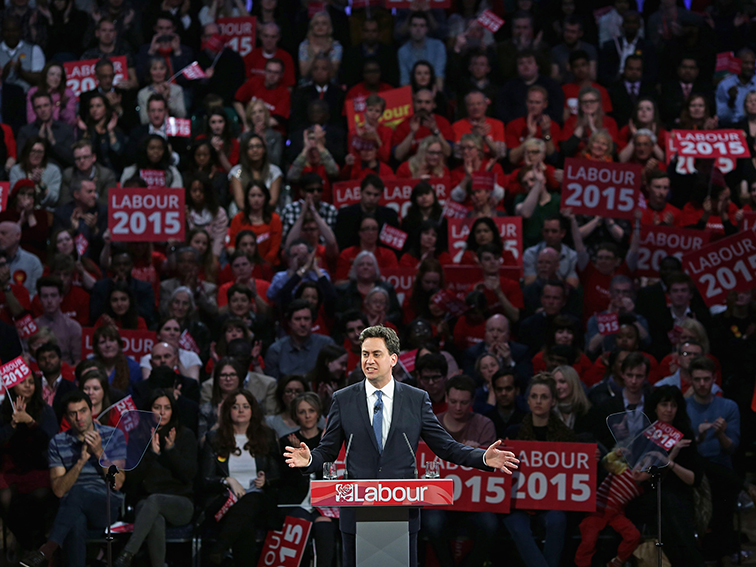
“On the day I lost the general election 2015, I thought to myself, you know… Errr, sorry I’m getting slightly emotional. I thought to myself, I’ve lost the general election. But you don’t need to be the leader of a political party to fight for big things.” He talked about those years, over a decade ago now: how he had a diagnosis about Britain after the 2008 crash; how he knew that “yearning”, “frustrated” people wanted “big change”. Beneath the crust of British society a volcanic, underground, pent-up demand for something better than the country we were becoming.
But he knew he had messed it up. It was all messed up, back then, in his head: the Ed Miliband who raged against Peter Mandelson, critiqued Tony Blair and Iraq, ennobled Maurice Glasman, slammed Rupert Murdoch; who wanted the working classes back in Labour; who desired to lead a Corbyn-style movement, not a political party; who employed “tough guy” Tom Baldwin as a spinner; who rhapsodised about “predistribution” – that Miliband was too cautious on austerity and listened too much, perhaps, to Ed Balls.
So no, no, no. He was not manoeuvring any more. He would be himself, drive through his policies, whatever it took. There might have to be some compromises along the way, sure, but if there was going to be a fight over net zero at the next election, Labour would fight, and it would win. “You think, look, you might as well just go for it. What’s the point otherwise? You might as well just go for it.”
Maputo, Mozambique, 17 August 1982. An hour before her assassination, the anti-apartheid activist Ruth First went shopping. “She was in a euphoric mood,” her daughter Gillian Slovo writes in her memoir Every Secret Thing (1997), after organising a successful conference on southern Africa funded by the United Nations. First returned from her shopping trip. “It was at that moment that Ruth must have slit open the buff UN envelope that had been sent to her. In doing so, she broke the circuit that had been carefully laid inside.”
First died instantly, killed by the South African police, leaving behind her husband Joe Slovo and their three daughters. Among the obituaries was one in the Socialist Register, written by Ralph Miliband, then one of the leading Marxist thinkers in the English-speaking world.
The Milibands and Slovos were friends; Ed can recall meeting Ruth when he was “12 or 13, and then she was murdered a few months later. I remember my parents still being incredibly upset about it.”
More than one friend of Miliband’s told me to read Slovo’s memoir. They suggested a parallel in growing up a Miliband and growing up a Slovo. Both families came from a now distant milieu of 20th-century secular-Jewish Marxism, survived the Holocaust, were refugees and then were politically influential as scholars and activists in their adopted homes. To understand Ed, I had to understand his parents and what it was like to be their son.
In Every Secret Thing, Slovo writes about being the child of internationally famous, even venerated, crusading left-wingers. “Even as children we carried internal scales of justice which we used to weigh up ‘their’ needs – the needs of the impoverished masses – against ours. How could we win? Compared to the poverty, degradation, discrimination they endured, our suffering was negligible.”
Recently, I asked Miliband if that was his experience. Every single colleague of his I spoke to mentioned an obsessive work ethic, bordering on neurosis. Where does that come from? Was he forced to be like that, maybe by his father, who by all accounts worked ferociously all his life? Did Ed feel a sense of guilt, the way that Gillian Slovo did? Was his suffering “negligible” compared to the struggle?
Miliband told me a story about his father that I had never heard before. Ralph didn’t like going on holiday, not really. He just felt lucky to have made it to England during the war. “When we used to go abroad sometimes to France, he came back and said, ‘Well it’s nice to go abroad but it’s much nicer to be at home.’” Miliband thinks that was the refugee in his father speaking. “I think their sensibility was, without ever saying it: we’re so lucky. We survived, so we’ve got a responsibility to leave the world a better place than we found it. That is definitely a burden as well as a great thing.”
The burden – that sense of survivor’s guilt from the Holocaust, the Marxist conviction that chains around the world were yet to be broken, that injustice and inequality were intolerable – that was what was handed down to Miliband by his parents. “We were not a religious family, but that’s what it must have been like to grow up in a religious family.” The Milibands looked to the future, their son becoming in the words of one colleague in government “hyper-progressive” because they could not look to the past. What happened in Europe was not something they wanted to dwell on, or remember. Look forwards. Make the future better than the past.
“The trauma of the Holocaust does echo down the generations in a way, people say this and, you know, I feel it myself,” he reflected. When he was climate secretary the first time, Miliband was once sent on an official visit to Russia in October 2009. As part of the trip he did a call-in segment on the Russian radio station Ekho Moskvy. An elderly woman called up. Her name was Sofia Davidovna Miliband. She identified herself as a long-lost relative, explaining that her grandfather was the brother of Ed’s great-great-grandfather, both of whom were from the Jewish quarter of Warsaw. I found the story flabbergasting, and when we spoke about it, Ed clearly still did too. I wondered what all this history was like for him to carry.
“Some people go through life thinking bad things are going to happen, and feel anxious about them happening. I’m one of them, and I think it must, in part, be because of the background I came from.”
Did Ed’s teenaged sons understand what the family had gone through? “Yes, definitely,” although it had been a “world away” for him, and he wouldn’t pretend it wasn’t distant for them. What did he hope for his boys? “Whether they’re happy, that they do something they care about, but they also do what makes them happy.” Miliband groaned slightly, comically. “Maybe I’ve just revealed the answer to the earlier question unwittingly.” I left thinking he might be raising his children differently from the way his parents brought him up.
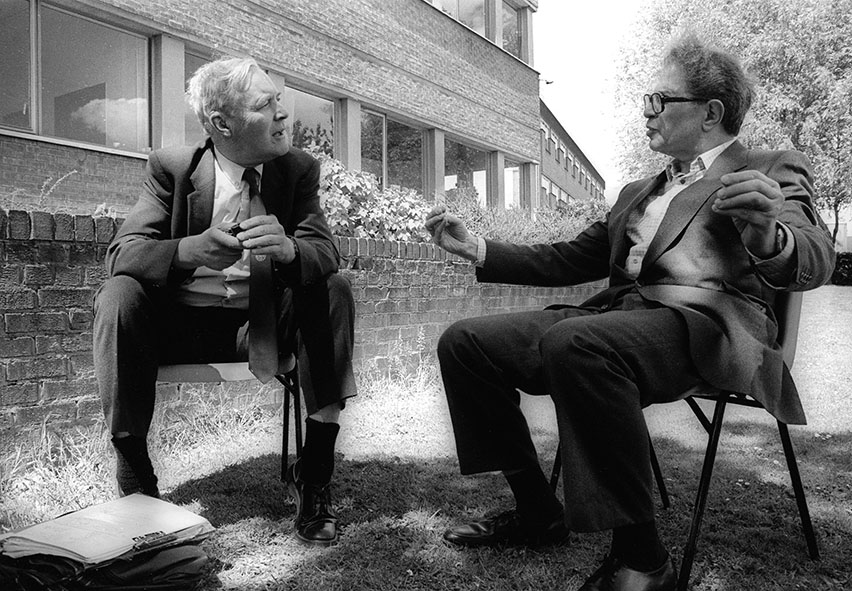
North Wales, November 2025. I met Miliband again on the train back to London. I apologised in advance that I was about to do something that, if I were him, I would find annoying. I took a copy of Ralph Miliband’s Parliamentary Socialism (1961) out of my bag. It might be his father’s most famous work, a scintillating attack on the Labour Party, which, in Ralph’s view, was little more than the graveyard of British socialism. “Ralph thought electoral politics was problematic for people who wanted socialism,” a family friend had told me, chuckling. That his son then became a special adviser in the Treasury is one of those facts about Ralph I could never quite get out of my mind.
Ed was fine about the book, so I read him a surging passage in which his father described the mood of the country in 1945, when Labour swept to power: “All this is not to suggest that the popular radicalism of wartime Britain was, for the most part, a formed socialist ideology, let alone a revolutionary one. But in its mixture, bitter memories and positive hopes, in its antagonism to a mean past, in its recoil from conservative rule, in its impatience of a traditional class structure, in its hostility to the claims of property and privilege, in its determination not to be robbed again of the future of victory, in its expectations of social justice, it was a radicalism, eager for major, even fundamental changes in British society.”
Was that not us? Was that not what the mood was like in 2024, and what the mood was still like today? Miliband stayed silent for a while. “I mean…” He wasn’t quite sure what to say. “That is brilliantly written. One thing about my dad is that he wrote brilliantly.”
I agreed eagerly. “That is such a brilliant paragraph.” He asked to take a photograph of the page. “I should go back and reread this. I don’t find it easy to read my dad’s books… He was my dad, it’s sort of… it’s sort of weird.”
Yet the influence is there. On the way to the last Labour conference, a friend of mine stole a glance at what Miliband was reading on the train. It was a speech Ralph had given at conference, 70 years before. In his own speech that autumn, the son alluded to his father.
Wasn’t Ralph Miliband really writing about us, writing about now? Yes, his son nodded. “Since 2010, you’ve talked about it, that feeling of coming to some kind of break with the past,” I said. “You’ve made a parallel with Thatcher before when you’re a leader.” Miliband agreed. “Shouldn’t this Labour government be one of those governments?”
“Yes.” Long pause. “You’re getting me to think about something I don’t normally think about every day.” Like what? “About New Labour, what did happen and what didn’t happen.” (Miliband remains close to Gordon Brown, with whom he speaks regularly. The relationship with Tony Blair, a net zero sceptic, is different. The pair haven’t seen each other in years.) “Social and economic change in Britain is hard. It’s hard because there are big countervailing forces that want to stop it happening.” There are the editorials again: madman, zealot, fanatic. “I’m not making excuses.”
“We won on a modest, relatively safe platform,” Miliband went on. “That’s not meant as a criticism. It’s just a description of the facts.” Miliband mounted a defence of the government. Good things are happening, he promised. The train rolled through North Wales, through Conwy, Llandudno, along the coast. The wan, autumnal sun was setting.
There are passages from his father’s last book, Socialism for a Sceptical Age, that Miliband can quote from heart. The book is a blueprint for an insurgent government, and was studied closely by some of Corbyn’s inner circle. Reading it in recent weeks I was struck by how prophetic it was, and how odd it must have seemed in 1994, published when social democrats were happily making their accommodations with capitalism after the fall of the Soviet Union. Those prophecies aren’t the passages that Miliband quotes though. He likes the last two lines of his father’s book, a blueprint for a future that still feels very far away.
“In all countries, there are people, in large numbers or small, who are moved by the vision of a new social order in which democracy, egalitarianism and cooperation – the essential values of socialism – would be the prevailing principles of social organisation. It is in the growth in their numbers and in the success of their struggles that lies the best hope for humankind.”
Whitehall, 12 March 2026. A few days before we met for the last time, Donald Trump started a catastrophic war in the Middle East. But in the UK it was all Ed Miliband’s fault. A leak to the Spectator the week before had accused Miliband, in an alliance with Rachel Reeves and Yvette Cooper, of stymying the Prime Minister’s efforts to join Trump’s war at a meeting of the National Security Council in early March. Unnamed “security sources” singled out Miliband as the biggest conflict blocker: “petulant, pacifist, legalistic and very political”.
The briefing was aimed to chop Miliband down. It fed into old memories of 2013, when he helped parliament defuse David Cameron’s desire to bomb Bashar al-Assad’s regime in Syria, and old calumnies against Ralph printed by the Daily Mail during Miliband’s leadership. It fed into the idea that in using some Chinese firms to ease the transition to net zero, rather than doubling down, as Trump’s America has, on fossil fuel extraction, Miliband was doing something against the special relationship and our long-term national interest. In any other northern European country, Miliband would have been seen as a fairly mainstream social democrat, even by his opponents. In Britain, he was deemed a traitor. The implications were enough to make your head spin.
While I worked on this piece, several China spying scandals appeared in the news. Miliband was attacked by Richard Dearlove, the former head of MI6, a man often condemned for his role in the intelligence failures leading up to the Iraq War, who thought that net zero was little more than a Chinese power grab over Britain. (China dominates modern industrial supply chains. It is quite hard to find an expert on the energy transition who believes it can be done without some engagement with Beijing.) On the right, the idea that Miliband’s windmills and solar farms were a “national security threat” was becoming common sense. Then the president himself launched his own assault: “Open up the North Sea! They got windmills all over the place that are ruining the country.”
I thought of Ralph Miliband’s writing about the security state, from 1994. Imagining a reforming socialist government taking power in a future Britain, he observes: “Members of the military and intelligence establishment would almost certainly view the government earmarked on courses which constituted a menace to the ‘national interest’, particularly as these courses affected their own domain; and they would naturally also take it as their duty to do all they could to defeat these policies.” If that was too far, too paranoid, there was, to my mind, an unmistakeable hint – not that Miliband would ever say it – of anti-Semitism in the intrigues around him. Could he really be trusted? Was he really a patriot? In what sense was he one of us? It reminded me of the bacon sandwich incident, something I had always seen as cruelly tabloid, silly even – until a friend, a British Jew, had told me that almost everyone Jewish they knew thought it was obviously an anti-Semitic dogwhistle.
A friend of Miliband called the “from the spooks presumably” leak “outrageous”. In his office in the Department for Net Zero, a grand if slightly cramped building opposite Horse Guards Parade on Whitehall, Miliband was terse, refusing to be drawn on it. “I’m not going to comment on what’s reported from the National Security Council.” He wanted a leak inquiry, and the Prime Minister knew what Miliband wanted to happen to the offender.
He looked amused when I mentioned Trump’s comments about Britain’s energy policy. “I’m not sort of surprised any more. I mean, this has been his consistent position.” He was more open about his dislike of Peter Mandelson, the man Morgan McSweeney believed capable of charming Trump into Britain’s orbit. Was it a good thing Mandelson had been sacked, investigated? “Oh yes.”
Miliband began thinking aloud about the Blairites – not, he insisted, “meant pejoratively”. To him, they had become statues, frozen figures unable to move with the times. “Tony Blair was elected 29 years ago. Times change. The world is very different. What did Tony Blair say? You honour your past but you don’t live in it.”
In February, Miliband signed an energy pact with Gavin Newsom, the Democrat governor of California. Miliband can quote Ted Kennedy speeches off by heart, and keeps a poster of Robert Kennedy (senior) in his parliamentary office. He has taught at Harvard. He is in regular contact with Columbia University’s Adam Tooze. He met the Biden team many times while they were in office. Miliband’s own successful tilt at the leadership of the Labour Party was based on the Obama insurgency. Now, though? What did he really think of Trump? The other side of American politics. The side that begins with Andrew Jackson, takes in Charles Lindbergh and George Wallace, and ends with Ice paramilitaries roaming through Minneapolis?
“America is aligning itself with the petro-states,” said a long-term Miliband ally, weeks before the bust-up in March. “Undermining support for the climate agenda and actively trying to destroy jobs in the renewables sector. This is an extraordinary, ideological campaign.” Miliband, they argued, will end up aligning Britain with the “electro-states” in Europe and, unavoidably, China. The clash between Labour and Reform in 2029 was not about values or any policy area other than this, in their view. “Farage is fifth column for a US-backed petro-state campaign in Britain.”
Miliband was never too explicit about these issues with me. His distaste for Trump was obvious, as was his fear at what the US was turning into. That did not mean he was throwing Britain into the unlovely embrace of the Chinese Communist Party. But it did mean the choices he was making were fraught with political risk and would attract suspicion from those who believed the UK could only succeed in the world as loyal satrap of the US, regardless of who governed from the White House.
The war was sending shockwaves through the global energy markets. At times it appeared to be dragging all of Labour’s aspirations in government down with it. And yet Keir Starmer and Rachel Reeves have doubled down on Miliband – and Milibandism. They believe, like him, that the price shocks are yet more evidence that Britain had to get off the “fossil fuel rollercoaster”. Their critics had begun to put intense pressure on the government to reopen exploration for gas and oil in the North Sea basin, something Miliband had effectively banned last November. To U-turn on this would be a catastrophe for him, personally and politically.
Either social democracy could be brought back online, or it was over, brought down by the shock of war. Either Milibandism’s time really had come, or this oil shock would do what its historic antecedent had done in the 1970s: sweep away a Labour government and clear the way for a revolution from the right. For Starmer and Reeves, for most of the Labour Party, the crisis only seemed to prove how right Milibandism had been all along. Not for the first time, the destinies of the British Labour Party and Edward Samuel Miliband have become one and the same thing.
[Further reading: The everything shock]
Content from our partners



Related


This article appears in the 25 Mar 2026 issue of the New Statesman, Easter Special
Join the debate
Subscribe here to commentYou talk about all the things you are not going to cover on Miliband junior but these are the things most people who are annoyed with him for allowing the Unions, especially Cluskey , to cause him to win by less than one percent of the vote on a Union turnout of less than 7% which should have been declared invalid. That the Labour hierarchy could not declare itself independent of the Union vote resulted in the better candidate, his brother, David, not winning the leadership and the Tories dominating politics for 14 years. I am aware of how hated David was by many in the hierarchy who were totally aware of their demise if he had won. Instead we got three years of “ Policy Review” while Cameron and Osborne imposed austerity on the country and 174,000 died of neglect. All the principles in the world are not worth anything if they ignore the realities of life for people unable to manage their existence.
The article twice mentions the crash of 2008, as if it had nothing to do with Labour. No-one would realise, if they were not sentient adults at the time, that Labour had been in power for eleven years.